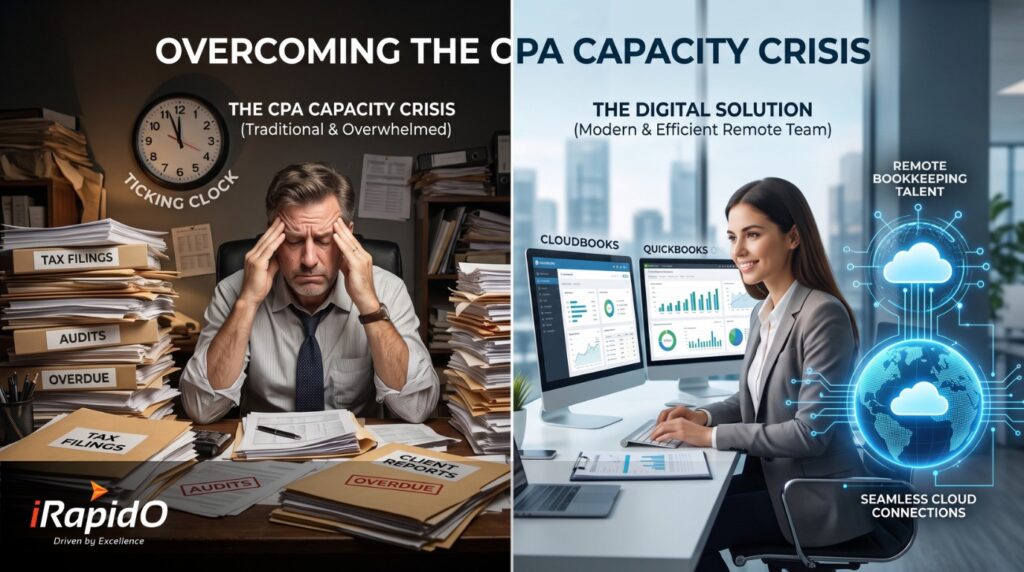
Across the United States, managing partners of mid-tier to enterprise-level accounting practices are waking up to a harsh operational reality. The candidate pipeline is rapidly drying up, experienced professionals are retiring at unprecedented rates, and a concerning percentage of new finance graduates are bypassing the CPA exam entirely.
The operational strain is palpable. Firms are losing mid-level accountants mere weeks before the busy season begins, leaving partners staring at growing backlogs and a stack of unfulfilled requisitions. The instinctual response for most firm leaders is to push HR to hire faster, increase base compensation, or increase signing bonuses. But as highlighted in our ongoing industry analysis, The CPA Files, hiring faster does not solve a structural industry deficit.
The Financial Drain of Misallocated Talent
The core issue fracturing US accounting firms is not just a lack of bodies; it is the fundamental misallocation of highly compensated talent. When a firm employs a $115,000 CPA to spend their week executing routine bank reconciliations, manual data entry, and baseline state filings, the firm is bleeding profitability.
This misalignment burns through capital, but more dangerously, it leads to severe employee burnout. Highly educated professionals want to engage in complex tax strategy, client advisory, and high-margin consulting. Forcing them into the daily transactional grind accelerates turnover, creating a vicious cycle of attrition.
The Operational Shift: The accounting firms winning in today’s market share a unified strategy. They have recognized that to grow their client base and protect their margins, they must build a specialized back office that rigorously protects the time and bandwidth of their premium onshore talent.
Restructuring the Firm: Decoupling Strategy from Transactions
To establish true resilience against the talent drought, firms must restructure their operating model. This requires dividing the firm’s deliverables into two distinct categories: high-level advisory and routine transaction processing.
By implementing managed financial back-office solutions, practice owners can instantly offload the heavy lifting of Accounts Payable (P2P), Accounts Receivable (O2C), and Record to Report (R2R) workflows. Relying on an enterprise-grade global delivery center ensures that all fundamental data processing is handled by certified professionals operating under strict US-GAAP compliance, entirely removing the burden from the onshore team.
Scaling Without the Friction of Local Hiring
The traditional model of maintaining a fixed local administrative team creates excessive overhead during slow summer months and dangerous bottlenecks during the January-to-April sprint. Utilizing remote ledger and transaction management introduces elasticity to the firm’s architecture.
A specialized remote capability team works seamlessly within your existing software stack—be it QuickBooks, Xero, or Intuit Lacerte. Operating across time zones, these teams can execute high-volume data categorization and reconciliations overnight. Your domestic CPAs arrive at the office to fully updated, audit-ready financial statements, allowing them to instantly transition into client review and advisory.
Comparing the Operational Models
| Operational Element | Traditional In-House Model | Modern Capability Center Model |
|---|---|---|
| Resource Allocation | Senior CPAs executing $30K routine data entry tasks. | Senior CPAs focused 100% on high-margin advisory. |
| Scalability | Constrained by 60-90 day local recruitment cycles. | Instant, elastic scaling to meet tax season volume. |
| Cost Architecture | High fixed overhead, loaded with payroll taxes and benefits. | Predictable, variable OpEx with 30-50% overall savings. |
| Staff Burnout | High risk due to continuous overtime and transactional grind. | Mitigated. Workloads are balanced and distributed globally. |
Frequently Asked Questions
What is back-office accounting outsourcing?
Back-office accounting outsourcing is the operational practice of delegating transactional financial management—including accounts payable, receivables, payroll processing, and reconciliations—to a specialized external provider to optimize costs and increase processing speed.
How do offshore accounting teams ensure US-GAAP compliance?
Reputable BPO partners employ certified financial professionals who undergo structured, ongoing training in US-GAAP standards, internal control frameworks (including SOX protocols), and US tax compliance requirements.
Can an outsourced back-office team integrate with existing corporate software?
Yes. Offshore capability teams operate directly within your firm’s existing financial software stack, including platform-agnostic tools like NetSuite, QuickBooks, Xero, Sage, and Yardi, ensuring zero disruption to existing Standard Operating Procedures (SOPs).
Stop the Bleeding and Redesign Your Staffing Model
Carrying multiple open roles into a busy quarter is a massive operational liability. The solution is no longer found on traditional job boards. It requires a fundamental shift in how your firm views its operational structure. By protecting your top talent from routine administration, you secure your margins, elevate your client deliverables, and fortify your firm against the ongoing talent drought.
Ready to Rethink Your Firm’s Staffing Architecture?
Don’t let the talent shortage cap your firm’s growth potential. Connect with our executive team at iRapidO to design a scalable, secure, and highly efficient back-office solution tailored to your practice.
Speak with an iRapidO Operations Expert
About iRapidO Global
iRapidO is a business process management firm specializing in Remote Capability Center solutions. Operating from our global delivery center, we empower US enterprises and financial leaders to scale operations, control overhead, and maintain long-term competitive advantage.