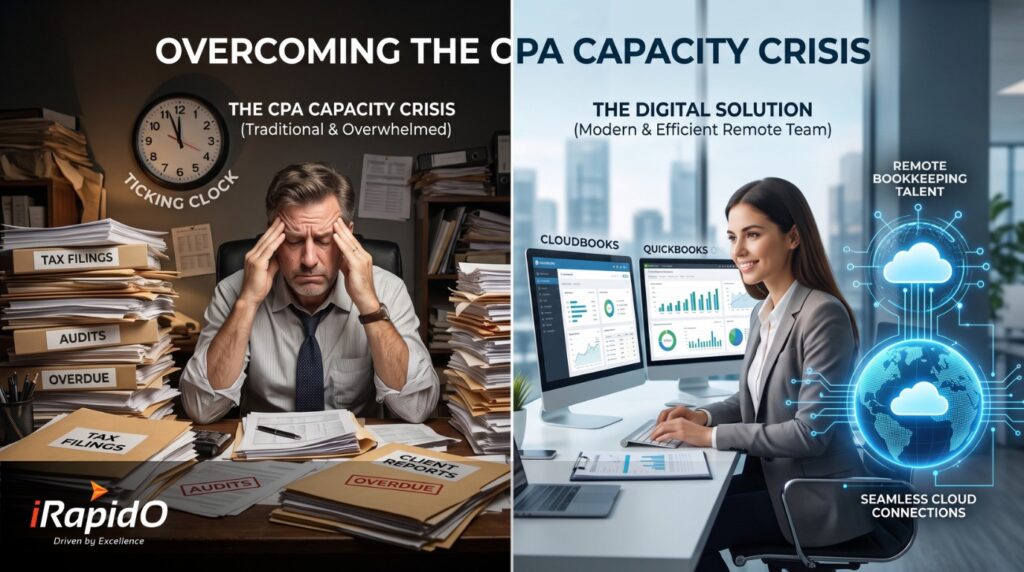
For Chief Financial Officers and executive leadership in mid-market US enterprises, maintaining structural profitability during periods of portfolio expansion represents a complex operational balance. As transaction complexity increases, managing expanding finance departments in-house routinely leads to inflated administrative overhead, reduced operational tempo, and key-person risk. Attempting to solve capacity constraints solely through local hiring often erodes corporate EBITDA.
To establish long-term financial resilience, forward-thinking executives are restructuring their operating architecture. By decoupling routine transactional data processing from onshore leadership and leveraging specialized outsourced accounting services, organizations transform fixed administrative expenses into flexible, high-performance capability centers.
Modern back-office transformation relies on delegating core transactional workflows—Order to Cash (O2C), Procure to Pay (P2P), and Record to Report (R2R)—to dedicated offshore delivery centers. This model reduces operational overhead by 30% to 50%, enhances data accuracy, and establishes 24/7 continuous financial processing.
The Hidden Costs of In-House Back-Office Administration
Expanding an internal finance team linearly alongside business growth exposes organizations to compounding overhead costs. The expense of a localized accounting department extends far beyond base compensation packages. US leadership teams must factor in several indirect operational cost drivers:
- Mandatory Overhead Burden: Employer-side payroll taxes, health insurance contributions, 401(k) matching, and paid time off (PTO) typically add 25% to 35% above base salary costs.
- Infrastructure and Technology Licensing: Local personnel require physical office footprints, hardware infrastructure, and per-seat licensing fees for enterprise ERP platforms (e.g., NetSuite, Yardi, SAP, or Sage Intacct).
- Operational Bottlenecks: Localized teams have fixed operational windows. During quarterly closures, year-end audits, or sudden M&A integrations, fixed in-house capacity can stall operations, causing reporting delays and management fatigue.
- Turnover and Single-Point Vulnerability: When an in-house controller or accounts payable specialist departs, business processes stall, requiring expensive recruitment cycles that average 60 to 90 days.
Core Financial Workflows Designed for Global Capability Centers
An effective outsourcing strategy preserves high-level strategic advisory onshore while transferring standardized transactional processing offshore. Modern business process management frameworks categorize these workflows into three core capability pillars:
1. Order to Cash (O2C) & Working Capital Optimization
Uncollected revenue directly constrains corporate liquidity. Dedicated remote O2C teams oversee billing automation, credit evaluation protocols, cash application, and systematic collections management. Streamlining receivables processing lowers Days Sales Outstanding (DSO), stabilizes working capital, and accelerates cash flow without diverting domestic management focus.
2. Procure to Pay (P2P) & Accounts Payable Control
Managing vendor disbursements requires rigorous governance to prevent duplicate payments, invoice errors, and internal control breaches. Remote P2P teams execute 3-way invoice matching, automated general ledger coding, and approval routing. This systematic approach ensures accurate cash outflow tracking while capturing early-payment vendor discounts.
3. Record to Report (R2R) & General Ledger Integrity
Timely access to audit-ready financial statements is essential for strategic decision-making. Outsourced R2R management standardizes general ledger posting, bank statement reconciliation, fixed asset accounting, and period-end close procedures under US-GAAP standards. Operating across time zones allows remote teams to complete ledger updates overnight, delivering clean reports to executive dashboards every morning.
Strategic Asset Comparison: In-House Team vs. Managed Offshore Delivery
| Operational Metric | Domestic In-House Structure | Managed Offshore Capability Center |
|---|---|---|
| Financial Cost Model | High Fixed Overhead (Base Salary + 30% Benefits & Infrastructure) | Flat, Predictable Operational Cost (30-50% Direct Cost Savings) |
| Operational Agility | Rigid. 60-90 days required to recruit and train local staff. | Elastic. Rapid resource scaling based on transactional volume. |
| Coverage Window | Standard 8-hour localized workday. | 24/7/365 continuous operational processing. |
Frequently Asked Questions
What is back-office accounting outsourcing?
Back-office accounting outsourcing is the operational practice of delegating transactional financial management—including accounts payable, receivables, payroll processing, and reconciliations—to a specialized external provider to optimize costs and increase processing speed.
How do offshore accounting teams ensure US-GAAP compliance?
Reputable BPO partners employ certified financial professionals who undergo structured, ongoing training in US-GAAP standards, internal control frameworks (including SOX protocols), and US tax compliance requirements.
Can an outsourced back-office team integrate with existing corporate software?
Yes. Offshore capability teams operate directly within your firm’s existing financial software stack, including platform-agnostic tools like NetSuite, QuickBooks, Xero, Sage, and Yardi, ensuring zero disruption to existing Standard Operating Procedures (SOPs).

About iRapidO Global
iRapidO is a business process management firm specializing in Remote Capability Center solutions. Operating from our global delivery center, we empower US enterprises and financial leaders to scale operations, control overhead, and maintain long-term competitive advantage.