Growth should feel rewarding. For many property management executives, peak season growth feels anything but.
As portfolios expand and doors increase, the operational load grows faster than expected. Leasing accelerates, maintenance volume spikes, renewals compress into narrow windows, and inboxes overflow. The pressure does not come from decision-making. It comes from volume. And volume has a way of exposing weaknesses in staffing models that look perfectly fine during slower months.
The default response is almost always the same. Hire more people.
Yet firms that repeatedly rely on headcount expansion to survive peak season end up paying for that decision long after demand subsides. The most resilient operators have learned a different lesson. Capacity does not have to equal payroll. The ability to outsource property management functions strategically is what allows firms to scale output without scaling overhead.
The Illusion That Headcount Equals Capacity
Adding staff feels like adding strength. In reality, headcount is a blunt instrument for a nuanced problem.
Peak season volume is uneven. Leasing surges at night and on weekends. Maintenance requests spike unpredictably. Renewals cluster by expiration cycles, not evenly across the year. Permanent hires are static, but demand is dynamic.
When firms hire full-time staff to handle peak workload, they create two problems. During peak months, new hires are often still learning systems and processes, contributing less than expected. During off-peak months, those same roles become underutilized fixed costs that compress margins.
Capacity is not about how many people are on payroll. It is about how efficiently work moves through the system.
Why Outsourcing Creates Elastic Capacity
Elasticity is the ability to expand and contract with demand. Traditional hiring lacks elasticity. Outsourcing is built on it.
When firms outsource property management operations, they gain access to trained teams that can be deployed when volume increases and reduced when demand stabilizes. This aligns labor costs with revenue cycles instead of locking firms into year-round commitments based on seasonal peaks.
Elastic capacity also removes the lag that comes with hiring. Recruiting, onboarding, and training take time that peak season does not allow. Outsourced teams are designed to integrate quickly, absorbing volume immediately instead of adding to it.
Where Capacity Actually Breaks Down
Most property managers are not overwhelmed by complexity. They are overwhelmed by repetition.
During peak season, administrative tasks multiply. Each leasing inquiry requires documentation. Each maintenance request requires intake and follow-up. Each renewal requires coordination and paperwork. None of these tasks are optional, but many do not require senior-level expertise.
When high-cost, high-skill staff spend their days on repetitive processes, capacity collapses regardless of how many people are employed.
This is why firms that outsource property management admin work often see instant relief without adding headcount.
Expanding Capacity Without Hiring: What Actually Works
Firms that scale without sprawl focus on redistributing work, not adding roles.
Leasing Operations
Remote leasing teams manage inquiry responses, application processing, screening coordination, and document preparation. Speed improves, conversion rates rise, and onsite teams remain focused on showings and owner communication.
Maintenance Coordination
Outsourced coordinators handle ticket intake, triage, vendor dispatch, and status updates. Property managers deal with approvals and escalations instead of chasing updates.
Renewals and Documentation
Remote teams manage renewal notices, follow-ups, lease preparation, and signature tracking. Internal teams focus on negotiations and retention strategies.
Each function removed from internal workload increases usable capacity without increasing payroll.
The Hybrid Model That Prevents Quality Loss
One of the biggest concerns executives raise is quality control. Outsourcing is often misunderstood as abdication. In practice, the most successful firms use a hybrid operating model.
In-house teams retain responsibility for relationships, decision-making, inspections, and escalations. Outsourced teams execute defined processes within established systems and controls. Clear boundaries ensure accountability without sacrificing speed.
Remote teams are treated as an extension of operations, not external vendors. They follow documented SOPs, use the same property management software, and participate in daily workflows. This structure preserves service standards while unlocking scale.
Why Timing Matters More Than Size
Capacity planning fails when it is reactive.
Firms that wait until leasing volume is already overwhelming attempt to solve structural issues under pressure. Training becomes rushed. Processes remain undocumented. Outsourcing feels chaotic instead of stabilizing.
The firms that succeed build elastic capacity before demand peaks. They identify bottlenecks early, document workflows, and integrate support teams while volume is still manageable.
Outsourcing property management operations in advance allows capacity to grow quietly in the background, without disrupting client-facing work.
Burnout Is the Real Scaling Limit
There is a ceiling to how much pressure people can absorb.
When peak season repeatedly pushes property managers into extended hours and constant task switching, burnout becomes inevitable. The most capable employees leave first, taking institutional knowledge and client trust with them.
Replacing them costs far more than preventing burnout in the first place.
Outsourcing reduces cognitive overload. It allows experienced staff to focus on high-impact work instead of drowning in administrative volume. This is how firms increase capacity without sacrificing retention.
A Practical Example of Scaling Without Sprawl
Consider a firm managing several hundred doors across multiple markets. Summer leasing volume increased year over year, but leadership resisted adding permanent staff. Instead, they outsourced leasing administration and maintenance coordination ahead of peak season.
The result was measurable. Response times improved. Property managers stayed within sustainable workloads. No new full-time roles were added. When demand normalized, costs normalized with it.
Capacity increased. Payroll did not.
Choosing the Right Outsourcing Partner
Not all outsourcing delivers elasticity. Generic staffing fails when teams lack industry context.
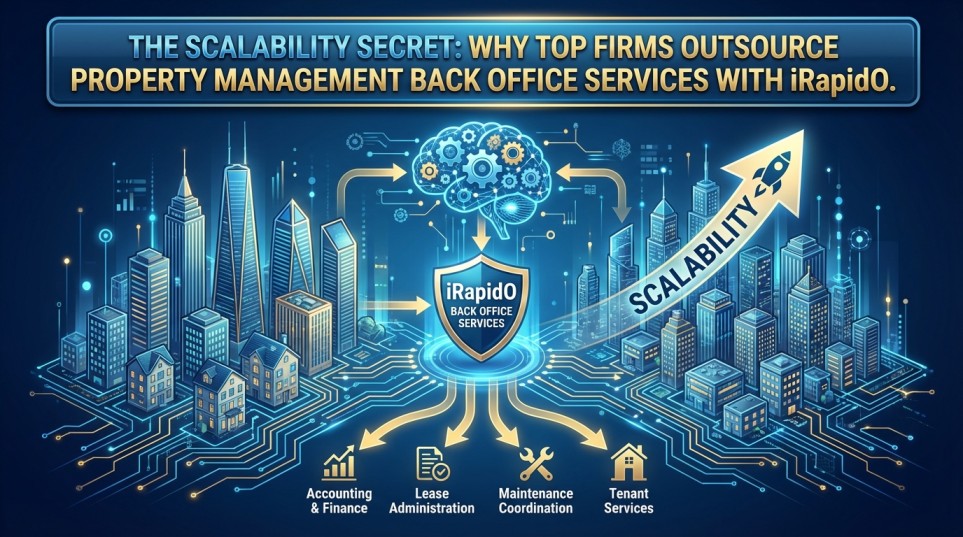
Providers like iRapidO focus on property management–specific workflows, systems, and compliance. This specialization allows remote teams to integrate quickly and operate with minimal oversight.
The goal is not cheap labor. The goal is predictable capacity.
Final Perspective for Executives
Peak season does not require bigger teams. It requires smarter systems.
Firms that outsource property management functions strategically expand capacity, protect margins, and preserve their core teams. They scale output without scaling sprawl. Growth does not have to be heavy. It can be elastic.
Ready to Scale Smarter? Stop letting peak season dictate your overhead. If you are ready to build a more resilient, elastic operating model, let’s talk. Fill out the contact form below to connect with an iRapidO solution specialist. We’ll help you identify exactly which administrative bottlenecks we can remove from your team’s plate—so you can grow without the growing pains.
Related Insights for Property Management Leaders: