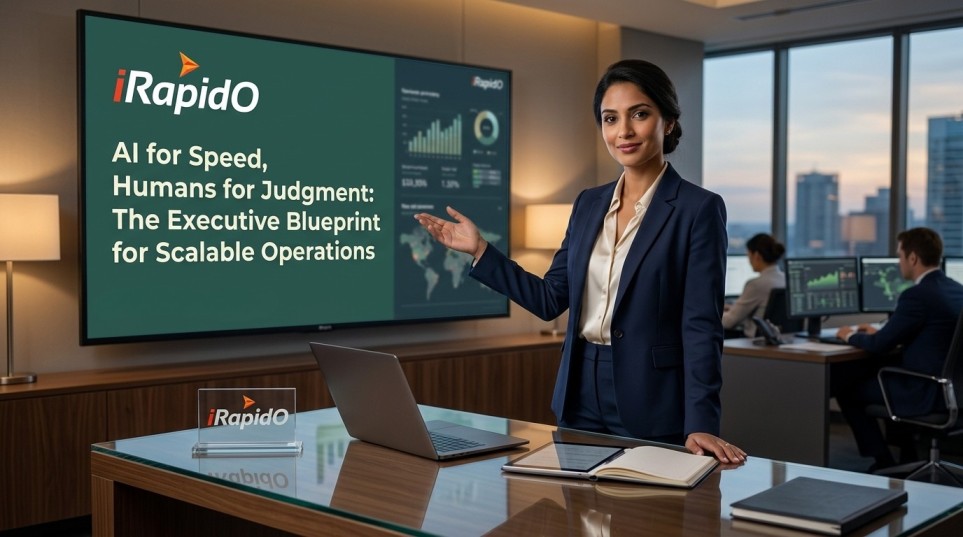
The modern property management executive faces a relentless paradox: scaling a portfolio aggressively while protecting Net Operating Income (NOI). For years, the industry’s answer to growth was linear—add more doors, hire more property managers, and accept shrinking margins. Today, the promise of automation offers a different path, but pure technological reliance introduces a new kind of operational fragility.
When algorithms encounter the unpredictable realities of real estate, they fail. The solution is not choosing between technology and talent. It is understanding their distinct operational roles.
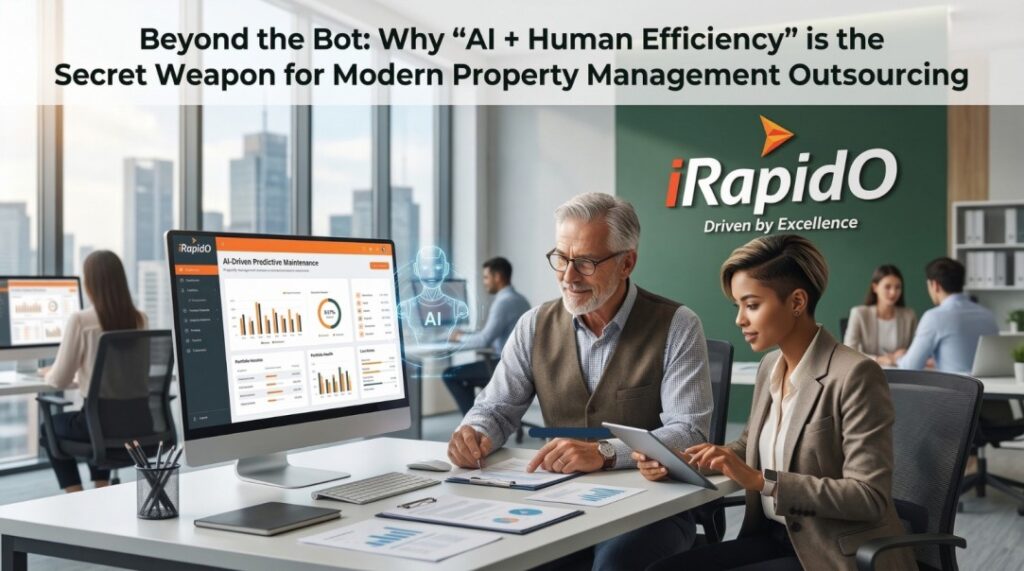
The formula for the modern, unbreakable business process management (BPM) engine is simple but profound: AI gives speed. Humans give judgment. Together, they create scalable operations.
Here is the executive blueprint for deploying a Human-in-the-Loop (HITL) architecture to scale your property management portfolio without compromising asset quality or tenant satisfaction.
The Automation Trap in Real Estate Operations
In property management, relying exclusively on software to scale creates an “automation trap.” While artificial intelligence excels at high-volume data processing, it lacks the nuanced reasoning required to navigate complex tenant disputes, vendor negotiations, and physical asset risks.
Technology vendors often sell executives on the dream of a “touchless” property management system. The reality of real estate, however, is deeply physical and inherently unpredictable. A burst pipe at 2:00 AM, a volatile lease negotiation, or a complex eviction compliance issue cannot be resolved by an algorithm.
When property management firms over-automate, they experience the “judgment gap.” This occurs when high-speed AI processes encounter edge cases they were not trained to handle. The result is operational friction: frustrated tenants, misallocated maintenance funds, and significant compliance liabilities. True scalability requires an infrastructure that anticipates these edge cases and routes them to experienced professionals before they impact the bottom line.
AI Delivers the Speed: High-Volume Processing at Scale
Artificial intelligence is the engine of operational velocity. By delegating structured, repetitive tasks to AI, property management firms can instantly process ledgers, triage maintenance requests, and audit lease agreements at a scale impossible for human teams.
To build a scalable operation, executives must ruthless audit their workflows to identify “speed tasks.” These are high-volume, low-complexity processes that drain human capital. In a mature BPM environment, AI is deployed to handle:
- Initial Maintenance Triage: Natural Language Processing (NLP) tools can instantly ingest tenant work orders, categorize the issue, and pull relevant warranty data without human delay.
- Lease Abstraction and Data Entry: AI models can rapidly extract critical dates, clauses, and financial obligations from hundreds of lease documents, populating your property management software instantly.
- Application Pre-Screening: Algorithms can process background checks, credit scores, and income verifications in seconds, moving qualified renters through the pipeline faster than competitors.
According to research from leading consulting firms like McKinsey & Company, integrating automated data processing can reduce routine operational costs by up to 30%. However, speed without direction is just accelerated risk. This is where human oversight becomes non-negotiable.
Humans Provide the Judgment: Risk Mitigation and Asset Protection
Human intelligence is the ultimate risk mitigation tool in property management. While AI organizes the data, trained professionals apply empathy, strategic reasoning, and industry expertise to protect the physical asset and optimize tenant retention.
Algorithms do not understand context. A tenant who is late on rent due to a banking error requires a different approach than a perpetually delinquent resident. A roof repair estimate needs a critical eye to prevent vendor price gouging.
In a scalable operations model, human teams are elevated from data processors to strategic decision-makers. They handle the “judgment tasks”:
- Complex Vendor Management: Reviewing flagged maintenance bids, negotiating with contractors, and ensuring the physical work meets quality standards.
- Tenant De-Escalation and Empathy: Handling sensitive lease violations, negotiating renewals, and providing the customer service required to keep occupancy rates high.
- Strategic Approvals: Making the final call on capital expenditures or complex compliance issues that carry legal or financial risk.
You cannot code empathy, and you cannot automate intuition. Human judgment is the safeguard that ensures high-speed processing translates into high-quality asset management.
The Blueprint: Building a Human-in-the-Loop (HITL) Ecosystem
The Human-in-the-Loop (HITL) model is the definitive blueprint for scaling property management. It integrates AI’s rapid execution with human oversight, ensuring that routine tasks are automated while complex anomalies are instantly escalated to skilled professionals.
Scaling successfully requires designing workflows where the handoff between software and staff is frictionless. A true HITL architecture in property management looks like this:
- Ingestion & Routing (AI): A tenant submits a maintenance request for a leak. The AI instantly logs the ticket, identifies it as a high-priority plumbing issue, and flags the unit’s warranty status.
- Review & Authorization (Human): The ticket is immediately routed to an outsourced BPM specialist. The specialist reviews the AI’s data, uses their judgment to authorize an emergency dispatch, and selects the most cost-effective, vetted vendor.
- Resolution & Auditing (Hybrid): The vendor completes the work. AI logs the invoice, but the human specialist audits the final cost against the initial quote before releasing payment.
This integrated approach allows portfolio directors to add thousands of units to their oversight without a linear increase in internal, onshore headcount.
Scale Without Compromise
The future of property management does not belong to the firms with the most software, nor does it belong to those relying on bloated, traditional staffing models. The competitive advantage belongs to the executives who seamlessly integrate artificial intelligence for maximum speed and outsourced human expertise for flawless judgment.
By balancing rapid processing with critical thinking, your operations become not just larger, but fundamentally stronger. Ready to build an unbreakable operations engine for your portfolio? Discover how our hybrid BPM solutions combine top-tier global talent with modern workflows to help you scale safely.